Pages

Showing posts with label immigration. Show all posts

Friday, 31 March 2017

Pato Branco

Pato Branco from the air, the yellow church is in the
middle of the shot
I must correct a terrible omission…  I have a blog about Brazil but have not written about the one place in which I have spent more time than anywhere else in Brazil – Pato Branco!  I have been coming here since December 2008 and have lived here since December 2015, how could I have missed this place?!

You can be forgiven if you have never heard of Pato Branco, it is a relatively small city deep in the countryside of southern Brazil.  With a population of just under 80,000 people, it is considered to be the capital of Southwest Paraná, one of the 3 southernmost states in Brazil.  I should point out that residents of neighbouring Francisco Beltrão (the “little city” is actually a bit bigger than Pato Branco, with a population just under 85,000) do not necessarily share this opinion, so I’ll move swiftly on. 


Where is Pato Branco?  From Google Maps
Pato Branco (meaning White Duck in English) is a very young city, marking its 65th birthday in December 2016.  It started life as a colony called Colônia Bom Retiro, founded in 1918 to resettle people unsatisfied with the result of a border dispute with the neighbouring state of Santa Catarina.  The name Pato Branco comes from a telegraph station Posto do Rio Pato Branco (station of white duck river) and people began to refer to the region as simply Pato Branco, becoming official in 1938.
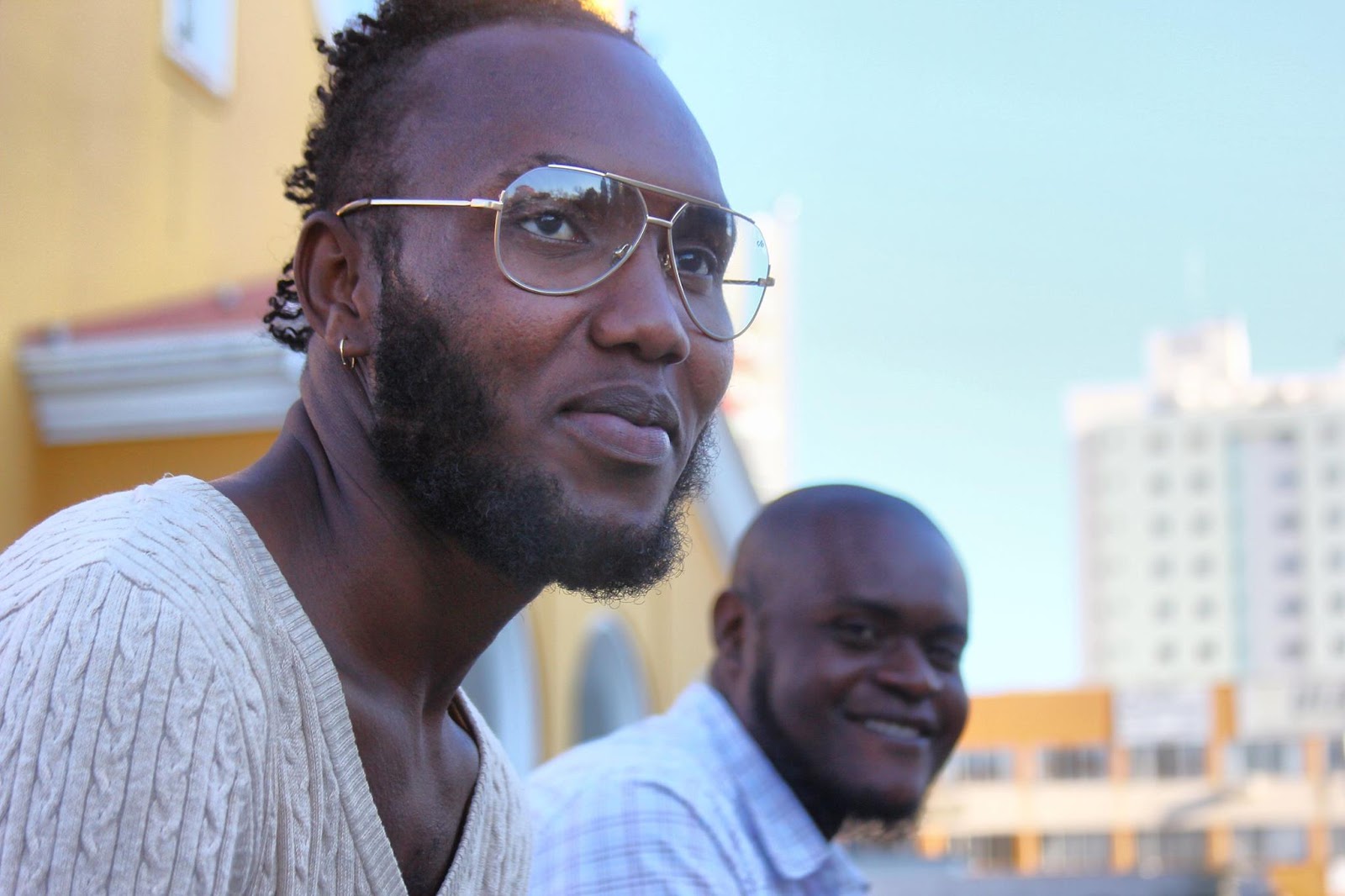
Two Haitian immigrants in Pato
Branco (photograph by Dan Jaeger)
The majority of the population is descended from European immigrants, in large part Italians from Veneto, in the North of Italy.  This has a marked influence on the culture of the city with many Italian-based customs and parties, a fondness for pasta and polenta and many shops and restaurants with Italian names.  There are also a significant number of people descended from Ukraine, Germany and Poland.  There is even a Ukrainian church in the city with Ukrainian parties and food.  This being Brazil, many of the cultures and traditions mix and it is not uncommon to meet people with recent ancestry from Italy, Ukraine, Germany, Portugal in various combinations!  Relatively recently, there has been a wave of immigrants from Haiti, with the largest community of Haitians in Paraná.  After the devastating earthquake in Haiti, several companies helped Haitians to obtain documentation to work, helping them to find housing and bring their families.  The Haitian community is generally happy in Pato Branco (except maybe for the cold in the winter months!) and are integrating well into the community.
 
The Ukrainian church (Paróquia Nossa Senhora do Perpétuo Socorro) in winter
Empty streets
The city is a small rural city with an economy based on agriculture, although in recent years it has seen growth in the areas of IT and electronics.  The city has been growing rapidly as a result of this change, with an increase in population from 72,370 in the last census in 2010 to an estimated 79,869 as of 2016.  This has changed the face of the city, even in the few years since I started coming here, there are considerably more apartment blocks, with several new buildings under construction.  In anticipation of further growth, there is a plan to relocate the city centre to an area just north of the city.  People have been buying up plots of land in anticipation of the move, although no one really knows when this will happen.  With the current recession in Brazil, the worst on record (according to the BBC), development has slowed somewhat with new roads running between empty plots of grassy land, waiting for movement. 


One thing that I have found funny since moving to Pato Branco; no one has asked whether I like living there, only whether I am “adapting”!  I’m not sure whether they are referring specifically to Pato Branco or to Brazil in general, but yes, I’m adapting!  It is a lot different to what I’m used to – it’s certainly not a large metropolitan area like London or the Bay Area and neither is it like a small town in Britain.  It has most of the services you would expect of a city – supermarkets, pharmacies, post office, hospitals etc – but the supermarkets close at 8pm and you’ll be lucky to find anything open on Sunday.  There is a cinema now though!  It opened a few months ago and means that you no longer need to drive 2-3 hours to find a cinema, though it does only have 3 screens (though having said that, it’s no different to where I grew up in a small town in Northeast Scotland.)  So yes, it is different to what I’m used to, but I am getting used to it, and it is a pretty town.

Praça Getúlio Vargas
Like many cities in Brazil, the centre of Pato Branco is well built-up, with several colourful apartment clocks, approximately 15 to 20 stories high.  This, as well as the numerous steep hills, gives the impression that the city is bigger than it is.  All the same, when you crest a hill and see the city spreading out with smaller houses, it’s clear to see how the city is growing.  It does still maintain a small community feel though.  The yellow church forms a scenic centre-point, and the fountains and trees of the Praça Getúlio Vargas directly in front of the church makes the centre of town a pleasant place to walk or sit and relax.  Indeed, at weekends and summer evenings, it is fairly common to see families gathered in the square talking and drinking chimarrão (a hot, yerba mate drink typical of Southern Brazil and Argentina.)


The accent and dialect is one area that I did struggle with, though.  When I started learning Portuguese, I mostly heard accents from São Paulo and Rio de Janeiro, with the São Paulo accent relatively easy for me to understand.  In Pato Branco, though, the accent is markedly different.  In much the same way as rural English accents can differ from more metropolitan accents, the rural Paraná accent is a lot different to the accent from São Paulo and even Curitiba.  Even now, having lived here for about 15 months, I can get caught out by some unusual expressions!

Birds flying around the church (Paróquia São Pedro Apóstolo)
(Photograph by Dan Jaeger)
The increase in population has resulted in increases in traffic, which has forced the city to make a string of changes to the roads to cope with the increased demand.  Some changes, such as replacing stop signs with traffic lights have greatly improved things for road users, while some changes are less welcome, such as changing some one-way streets (which worked due to alternating the direction of traffic on parallel streets) to two-way without reconsidering the traffic signals, which no longer leave time for pedestrians to cross, meaning you have to take your chances and hope that a car doesn’t come flying around a blind corner.

Pato Branco = White Duck
The city become well known in Brazil as a result of a comedy, “Toma Lá, Dá Cá,” which featured a character from Pato Branco with a strong countryside accent constantly telling long-winded folk tales about the people of the city.  The first time I became aware of this, I was in a restaurant in London with my wife (girlfriend at the time) and she noticed that the waiter was Brazilian.  The restaurant wasn’t busy se we chatted with him and he burst out laughing when she said she came from Pato Branco – he thought it was a fictional city!  It wasn’t the first time I found Brazilians laughing about the name of the city.  The city is also known for being the home of footballers Alexandre Pato (who played for the national side, and teams including Corinthians, Milan and Chelsea) and Rogério Ceni, the former goalkeeper of São Paulo.


Pato Branco is a lovely, peaceful city that’s perfect for raising a family.  There is a strong economy and, with the upcoming opening of the airport to commercial flights, I am sure the city will continue to grow and prosper.

The city centre, shortly before a summer storm

Thursday, 10 March 2016

I’m not a Number, I’m a Free… Oh Wait, I’m 123.456.789-01

I’m also G123456-7, 123.45678.90-1 and 1234567 (obviously not my actual numbers, but you get the point.)  One of the strangest aspects of living in Brazil is how much of your life is governed by documents and numbers. 

In Britain you occasionally need your national insurance number to work, to deal with your taxes etc and in the US you need your Social Security number for that and to buy a phone, set up cable tv etc.  The equivalent in Brazil is the CPF, (Cadastro de Pessoas Físicas – literally Individual Registration) which is your tax ID.  You need this ID to work, pay taxes, buy electronic goods, stay in a hotel, make a coach journey… you name it, you probably need your CPF for it.  Some states have also set up a voluntary scheme where you give your CPF at the till in shops and for each R$50 you send in a month, you get an electronic ticket for a draw to potentially win a cash prize up to R$50,000 (and on special dates – whatever that means – up to R$200,000.)  From what I can tell, this scheme was designed to encourage spending and stimulate the economy.  I first heard of this when I visited São Paulo last year – I found it strange that even supermarkets were asking for CPF – and now it has arrived in Paraná and various other states.

CPF - this used to be a card, but now, they
just send you a black and white pdf to print
After your initial registration in Brazil, applying for a CPF is one of the first things an immigrant needs to do.  I’m told that you can do this at a bank or post office, although as my company was assisting with my documents, an immigration consultancy company handled mine for me.  This involved signing a power of attorney form, having it notarised (Brazilian bureaucrats love notarising) and sending it by SEDEX (fast, secure mail service) to the lawyers.  As this took place over the Christmas and New Year break, it took over a week.  I since found out that when you apply for a CPF at a bank or post office, you get your number there and then – having the lawyers take care of it turned out to be a waste of time and I would only advise anyone to do this if they do not speak Portuguese and do not know anyone that speaks Portuguese and their own language (which would make living in Brazil hard enough.)

The CPF is one of the documents used most often when living in Brazil, the other is the RG (Registro Geral – literally General Registry) which is the ID card required of every Brazilian which has an identifying number (of course) a photo and thumb print as well as personal information such as date and place of birth, parents’ names and signature.  Only Brazilian citizens can have an RG, foreign residents have an RNE (Registro Nacional de Estrangeiros, literally National Registry of Foreigners), which is a salmon-pink card with the same details as the RG as well date of entry into Brazil, classification (permanent or temporary)  expiry date of the card.  I should point out that RG and RNE are not the official names of the card, but rather the identifying number written on it.  As this is the information usually required, it’s more convenient to refer to the cards as RG and RNE.  The full names are Registro de Identidade Civil (civil identity registry) and Cédula de Identidade de Estrangeiro (foreigner’s identity card.)

As an immigrant in Brazil, registering for your RNE is one of the first things you do.  A requirement of my visa (and I assume any type of immigrant visa) was that I register with the Federal Police within 30 days of arriving in Brazil.  For this, you need to take the following documents:
RNE - ID card for foreign residents in Brazil
  • Passport and a copy of all of the page of the passport
  • Original visa application form (this is the form that was given to you at the consulate when your visa was issued)
  • 3 recent colour photos against a white background, size 3x4
  • Copy of proof of address (doesn’t need to be in your name, but must be where you live in Brazil)
  • Copy of spouse’s RG and CPF (if it is a marriage visa)
  • Marriage certificate and “legalised” marriage certificate (from the Brazilian consulate, you needed this to get the visa in the first place!  I wasn’t told about this by the immigration consultants, luckily I thought to bring them along just in case)
  • Entry/exit card from your arrival in Brazil
  • Previous protocol (if you have previously applied)


At the end of the appointment, you will be given the Registry Protocol – a slip of paper with your photo which confirms that you have registered with the Federal Police.  Until your RNE arrives, you will need this to open a bank account, apply for a CPF, notarise documents etc.  I was told it may take up to six months for the RNE to arrive, but mine took two months.


But that’s not all!

CTPS - Work and Social Security Booklet
The final document you will need if you are going to work in Brazil is the CTPS (Carteira de Trabalho e Previdência Social – work and social security booklet.)  This document is a small booklet that looks like a passport and contains a photo, thumb print, personal details and two more numbers (one is the number of the document, the other is a social security number.)  Any time you start a new job, the details are written (or in my case, printed and glued) into the booklet with details of the employer and salary.  If your salary changes, then it will be updated in the work booklet.

This booklet is issued by the Ministério do Trabalho (ministry of labour) and you can usually apply for this at a regional agency, which can be found in most major cities.  Foreigners, though, will need to go to a “Gerência Regional” (regional management office) which can only be found in a few cities.  As Pato Branco only has an agency, I had to go to Cascavel, three hours away.  The documents required are:

  • Passport
  • Original and copy of the RNE protocol
  • Original and copy of proof of address (again, it doesn’t need to be in your name, just the place where you will live
  • CPF Number

The process only took about five minutes, as my documents were checked and entered into the computer and my photograph was taken along with an electronic thumb print.  I was told that 10 days later, I could collect my CTPS from the regional agency in Pato Branco.  Once I had it, I sent it to my company’s Brazilian office to enter the details of my employment.


Now all I need is my Brazilian driving licence, although I can drive using a foreign licence for my first six months in the country.  To be continued…