Pages

Friday, 8 January 2016

The Best Burger in the World

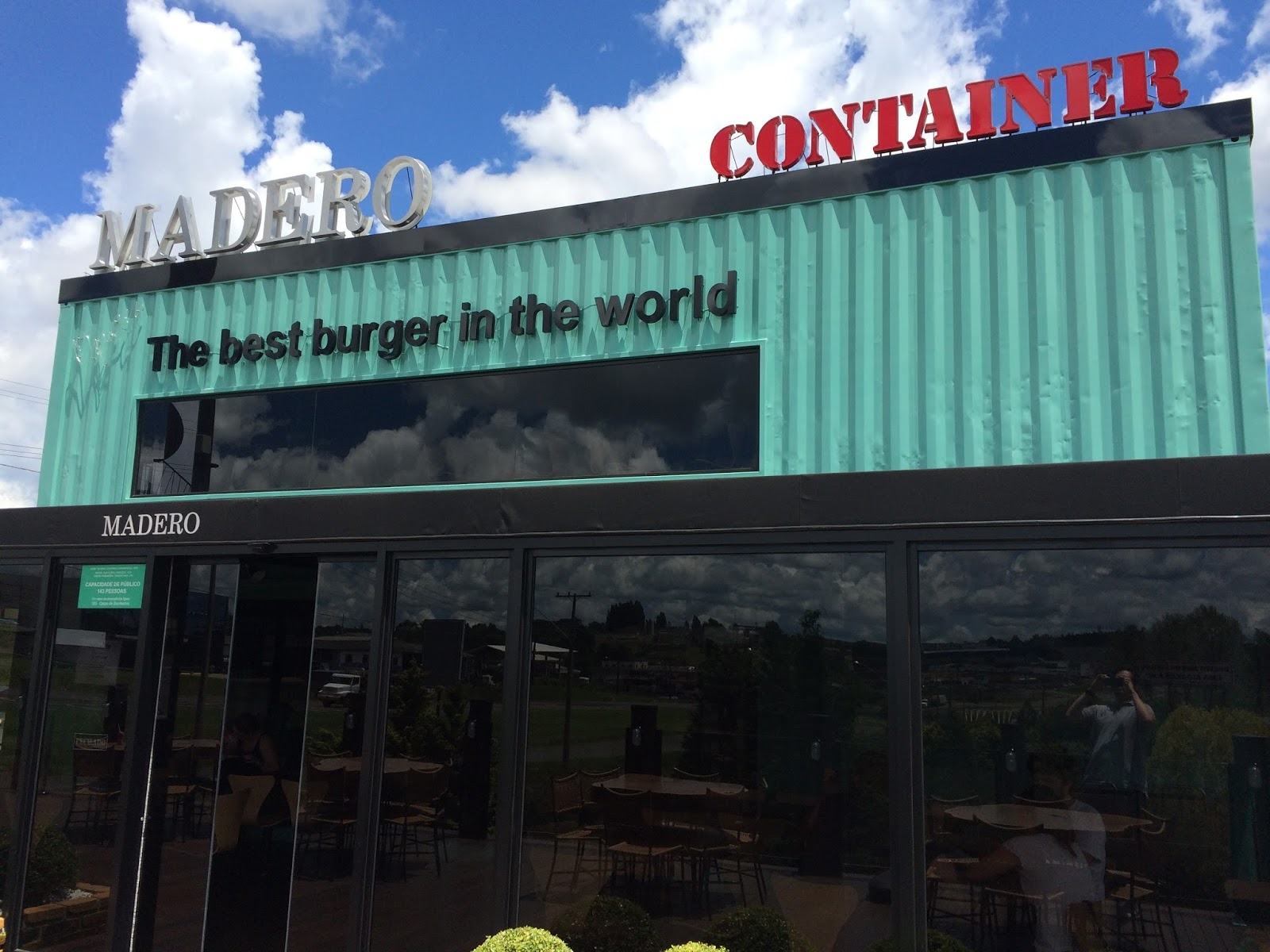
Madero Container - roadside restaurants made from converted
shipping containers.  Surprisingly comfortable inside!
I saw it in a shopping centre in Curitiba, a fancy looking restaurant called “Madero” proudly proclaiming (in English) to be the makers of the “Best Burger in the World.”  Hmmm, I thought, starting to feel hungry.  But it was about 10am, nowhere near lunchtime.  Next time I saw it, we were on our way to meet friends for lunch elsewhere.  I heard people talk about it, people asked if I had been then told me to go.  I even saw signs advertising branches at motorway rest areas/ petrol stations (Madero Container, made from converted shipping containers), but alas, still nowhere near lunch time, not to mention too close to the start of our journey (6 hours, from Curitiba to Pato Branco.)

But then I saw it again; just inside the entrance of a shopping centre in Cascavel, Madero and the “Best Burger in the World.”  It was 11:30am, but I’d been up since 5am and damn it, I was hungry.  So finally, I would satisfy my curiosity, I was ready!

But they weren’t, opening at midday – DAMN! Never mind, kill a bit of time, look in some shops, wait expectantly by the door…

A typical 'por kilo' restaurant
The culture of food is a bit different in Brazil to what I’m more used to in Britain (and to some extent America – where food is similar but bigger.)  A type of restaurant very popular is the 'por kilo' ( per kilo) restaurant, a hot and cold buffet where you pay for as much or as little as you want, by weight.  Unlike in Britain, where buffet restaurants tend to be an underwhelming affair, these restaurants usually have good quality, tasty and fresh food.  Don’t get me wrong, you may well find a cheap by-the-kilo restaurant that’s not so great, but you can also find up-market restaurants with high quality food and prices to match, everyone is accommodated for.


Fast food also has its place in Brazilian cuisine, but again the rules seem different.  Take McDonalds in Britain or America, the food is cheap making it a quick and easy way to eat, to the point where I’ve seen many homeless people going there as a dollar will go a bit further.  In Brazil, I’m told (I haven’t been to McDonalds here and it’s not exactly high on my to-do list,) it’s considered more of an up-market affair.  It isn’t the cheap option and going is more of an occasion.

Which takes me back to Madero, billed as a steak house, but obviously very proud of its burgers.  The restaurant is nicely decorated and the wide selection of food and drink available in the menu show that this isn’t just a fast food joint.  The first pages offered some healthy options, but I skipped that and sought out this “Best Burger in the World” I’d been hearing so much about.  I’ll have the bacon cheese burger please, no tomatoes. 

Madero "Bacon Cheese" with no tomatoes (see flag)
with a bottle of Guarana to wash it down
The burger arrives partially in paper (Brazilians generally don’t like touching their food with their hands) in a crunchy bread roll (works for me!) and not too many chips (or French fries, if you must…)  I must say it’s nice to eat out without being faced by an insurmountable mountain of food, I prefer quality over quantity any day.


So was it the “Best Burger in the World”?  I don’t know exactly, but it’s definitely up there with the best of them (by which I mean burgers that contain actual meat) with extra points for including thick bacon that tastes like bacon and hasn’t been incinerated.  I suppose I’ll have to go again to make my mind up.

Note: This post was NOT sponsored by Madero!  But if they want to give me a free burger, I wouldn't say no!

Saturday, 26 December 2015

Christmas in Brazil

This was my third Christmas south of the equator, but it still doesn’t quite seem right that it is warm!  My First Christmas in Brazil saw me going for a walk in Ibirapuera Park in São Paulo on Christmas Eve, where I got sunburn.  My second was a year later, in Pato Branco and the third seven years after that, also in Pato Branco. 

It’s a strange experience wearing shorts and t-shirt to do your Christmas shopping (if you grew up in Scotland at least,) and the only people dressed in what I consider to be a seasonal level of clothing are the long suffering Santa Clauses, dressed in the traditional gear in 30 degree heat.  The material doesn’t look quite as heavy as a Santa in Europe, but it’s enough.  I’ve heard stories of Santas passing out in the heat, so maybe it’s time to update his clothes south of the equator.  Maybe he’d be happier in the surfing garb in which I saw him dressed on a poster at a water park!

In recent years, Pato Branco has become quite famous in the local area for its “Opening of Christmas” at the end of November.  They have a brightly lit parade through the town with singing, a light show projected onto the church and a fireworks display.  We arrived too late for the main event, though we saw the “Minidesfile” (mini parade) on 13th December. 

My wife’s family has a tradition of doing a Secret Santa (or Amigo Segredo (secret friend) in Portuguese.)  For anyone not familiar with this, everyone draws a name from a hat and that is the person you need to buy a present for, usually in a fixed price range.  As an added twist, the family also does Inimigo Segredo, or secret enemy, where a joke present is given first, before revealing the actual present.  This year, we went hi-tec (sort of…) and found an app that would send the details via e-mail allowing people not present at the drawing to be given a name and ensuring that no one picks their own name.

I must say I like this system – there’s nothing worse than going through the list trying to think of an original present for everyone then falling back on that old faithful standard of socks, this way you put your effort into that one present (and a bit of effort into the Inimigo Segredo too!)  It also levels the playing field a bit so no one feels that they have to compete to buy the most expensive present.

In Brazil, the main event is on Christmas Eve, the day that Brits are finally saying goodbye to work.  Everyone goes round to one house, exchanges gifts and waits until midnight to eat a Christmas dinner.  Theoretically…  Sometimes it’s easier to have that dinner at 9 or 10pm, and who wants to be going to bed full?  This year, to save anyone from cooking, dinner was ordered from a restaurant that closed its doors for normal service, to concentrate on catering for Christmas meals.  The order was placed a few days in advance, and we collected it at 8:30 on Christmas Eve.  It was an excellent meal of roast turkey, roast leg of pork, rice, maionaise (Brazilian potato salad), farofa (crunchy goodness that I will explain elsewhere) and salad.  Dessert was panettone, a sweet Italian loaf, popular in parts of Brazil that saw a high level of immigration from Italy. 

Despite being a religious, Catholic area, there does not appear to be a tradition of midnight mass, as can be found in Britain.  Instead, everyone gathers round, joins hands and recites the Lord’s Prayer (and some others that I didn’t recognise.) 

Christmas Day itself is still a holiday in Brazil, but the traditions are a bit more relaxed than Christmas Eve.  The family gathers for a barbecue at lunch time – a proper southern Brazilian barbecue that is.  Large cuts of meat and all the usual trimmings – we’re not talking hamburgers and hotdogs!  The rest of the day is spent gradually winding down and then thoughts begin to turn to New Year.

Thursday, 24 December 2015

Bem Vindo ao Grupo de Suporte para Casados com Brasileiras

Eu iniciei esse blog quando morava nos Estados Unidos, eu e um amigo britânico (que também é casado com uma brasileira) nos encontrávamos para tomar café e conversar.  Um dia, de brincadeira, eu disse que devíamos criar um grupo de suporte para casados com brasileiras.  Em primeiro lugar, eu escrevi sobre o Brasil para estrangeiros, como comida, viagens pro Brasil, política etc… coisas da vida diária de um casal anglo-brasileiro.


Em Dezembro 2015, minha mulher e eu mudamos para o Brasil, mais especificamente Pato Branco no sudoeste do Paraná. Por enquanto estou escrevendo meu blog em Inglês, mas percebi que muitos brasileiros tem interesse em saber a opinião dos gringos sobre o Brasil. Por isso, eu pretendo escrever alguns coisas em Português (pelo menos, para praticar Português!)

Why I Came to Brazil

When I first mentioned that my wife and I were moving to Brazil, I got a wide range of responses, from “cool” and “great” to “but the economy is so bad” and “WHY?????”  And that was just from Brazilians.  Others from elsewhere commented about how great it would be,  some asked whether it is dangerous (or in some cases “how dangerous is it?”) while an inevitable few became instant experts on Brazil and proceeded to tell me all about it (of course, most of the ‘facts’ were wrong…)  The truth is that I’m not living by the beach, spending my time surfing, nor am I swinging from tree to tree in the rainforest or only breaking up my keepie-uppie practise with games of football.  And I’m not having to scrimp and save for a scrap of food, nor am I dodging bullets in a drug war or wrestling snakes and alligators (sounds fun though!)  In this post, I’ll try to address the panicked “WHY?????” and show that I have not taken complete leave of my senses.

Family


This was the main reason for the move.  We had been living in the US for the past 4 and a half years, which meant that holidays were spent dividing our time between Britain and Brazil so that we could see our families.  Even so, given the costs of international travel and the time it takes to make these trips, we could only realistically hope to visit each country in alternating years, with any extra trips being a bonus.  By living in Brazil, trips to Britain could become more regular and visits to the Brazilian side of the family could be easily accomplished over public holidays, of which Brazil has many!

America’s not all that


As strange as it may sound to some people, we didn’t particularly enjoy living in the US.  I found that life seems to revolve around business (I’ve always believed in working to live, not living to work) and shopping.  A real me-first mentality seems to come forward in all areas of life, whether it’s fiercely competitive driving or the sheer revulsion felt when mentioning the idea of nationalised health care (“why should I pay for someone else’s healthcare?”  Maybe because someone else will later be paying for your healthcare.  I’m not going to dwell on the healthcare issue, but it’s something I feel very strongly about.)  Then there’s the bizarre, fevered military worship, nonstop consumerism and bizarre politics.  Some people like the American way of life, and to those, I wish the best of luck – go forth and be happy!  I don’t, so I opted for a change.  The options left are Brazil or Britain and I had the feeling that if we returned to Britain, we probably wouldn’t get the chance to try Brazil, so we went for it.  If it doesn’t work out, we’ll be moving back to Britain.

Lifestyle


It may have become a tired old cliché and the reality is often warped into a cartoonish stereotype, but the Brazilian way of life really appeals to me.  I have found Brazilians in general to be friendly and open, not averse to making friends.  Brits, by comparison, can be a bit more distant and reserved, often taking longer to build a friendship.  On the other hand, American culture (or at least in the San Francisco Bay Area) seems to revolve around networking.  In both countries, initial conversations tend to start with questions about what you do for a living, while Brazilians are more likely to take an interest in you as a person.  You’re more likely to be asked about your football team than your profession.

The Food


a selection of salgdinhos - small savory snacks
A lot of people asked whether there were things I'd miss from the US or Britain (in the Bay Area, it's possible to find a scattering of British shops with life-saving packets of Tetley tea and Hobnobs.) There are certainly foods that I'll miss over time, but there are so many foods here that are better than elsewhere.  I find it's better to enjoy what you have, rather than pine for what you don't have.  What I can find here is: Guaraná Antarctica, coxinhas, catupiry cheese, pasteis, rissoles, pão de queijo, Brazilian barbecue, feijoada, farofa, a huge array of fresh fruits, açaí, mandioca... the list goes on!

The Weather


This is the area where I encountered the most instant experts.  It’s going to be hot all year round, it’ll be sunny all the time etc etc.  In parts of the country, this may well be true, but I’m living in the South.  The summer here is generally warm, with sunny days, humid days and rainy days.  When it gets too hot and humid, it is generally not long before a heavy downpour cools everything down.  Of course, some places get too much rain, and summer can often be a time of floods, especially in parts of Santa Catarina and Rio Grande do Sul. 
Summer in Curitiba


Winter, on the other hand, can be bitterly cold (or so I am told, I’ll soon see for myself.)  While temperatures might not plummet to the depths experienced in Northern Europe, Canada or the Northern states of the US, it came get pretty chilly in the South.  This is compounded by the fact that houses are built to let out the heat and are generally not centrally heated as in colder countries.  Fortunately the winter does not last that long.

Countryside


Brazil has a really beautiful countryside, covered with mountains, forests, rivers and waterfalls.  Taking a drive across the state of Paraná will take you over wide, rushing rivers, through dense forest, between scenic mountains and across hillsides and fields that remind me of the English countryside.  Everywhere looks green and alive.


The Beaches


I know I said I’m not living by the beach, but I’m not that far away!  Brazil has so many incredibly beautiful beaches with warm seas, it’s no wonder Brazilians love to go to the beach and that it is one of the few things that foreigners definitively “know” about Brazil.  Even in the South and South East of the country, there is a lot of choice available: do you want a surfer’s paradise with huge waves?  Do you want a quiet relaxed beach surrounded by forests and the nearest cars some distance away across a stretch of sea?  Do you want somewhere close to civilisation, with all the trappings of food and drink service, Havaiana sellers and fresh coconut water?  Do you want to squeeze yourself into a beach jam packed with people (not my thing, but whatever makes you happy…)?  All of these are on offer, plus many more.  I’ve seen so many photos of beaches in the North and Northeast that I’m itching to visit.

Football


Football is a big part of life here.  Even the few Brazilians I’ve met that aren’t interested in the sport generally have a team that they sympathise with while for real fanatics, the team is like an extended family.  It’s a great feeling to meet with friends at a bar before a big match, where everyone is happy and wearing the team’s colours, then proceed to the stadium where the atmosphere is nearly always electric (although this can easily change if the team is not playing well enough.  I’ll never forget one particular match between Atlético Paranaense and Maringá where our team was being outclassed by a far inferior team and the fans started chanting “time de merda!” (shit team.)  Don’t upset your fans!  The other reason I like football in Brazil is that it is for everyone, it isn’t considered just for the men as in some other places.  I met my wife in the hairdressers once, where she was discussing the team’s performance with another woman and you can always see families going to the game together. 

The Crisis


Brazil is currently in the grip of a recession, which has really put a dampener on the spirits of the population and often an air of pessimism sweeps through the society.  The problem with recessions is that they seems to become self-fulfilling prophecies: people lose confidence and tighten their belts, with the result that businesses make less money, the results get worse, people and businesses lose even more confidence and the cycle continues until gradually things improve and the country is pulled out of recession. 

Being born in Britain in the early 80s, I am accustomed to market scares, crises and recessions, the economy of a country always appears to be a roller coaster ride with rises, dips and the occasional loop!  But the Brazilian economy has been steadily rising since the 90s.  Under President Fernando Henrique Cardoso, the economy went from strength to strength and remained strong during the government of President Lula (I’m not going to get into politics here.)  Now the economy has started to slip, and it feels as though people expect that it’s just going back to dark times of high inflation. 
Recessions are never good news, but I don’t see it as a reason to panic and flee the country.  The end is not nigh!

Politics and Corruption


This is what annoys me about Brazil, rampant corruption and shady politics.  It seems too easy for people in positions of power to embezzle money and ensure that the rich get richer.  But I think that things are slowly changing.  Investigations have been launched into massive money laundering circles and corruption within Petrobras, the state petroleum company.  The investigators are getting close to the once-untouchable former President Lula, a Senator (as well as many company executives) has been arrested and an impeachment process has been initiated against President Dilma.  While some people see this as a national embarrassment, they should realise that it should be a source of national pride.  It is important that no one is above the law, and those to steal are held accountable.

It is my hope that through these investigations, the political systems can be reformed to make it difficult to steal money and that those corrupt politicians will not be able to drag down the economy and perception of this country that deserves to be great.
Protest against corruption in March 2015.  The protesters all wore national
colours to show support for Brazil, rather than political allegiance

Saturday, 19 December 2015

The Big Move

I woke up with a headache.  The last few days of long days, short nights, endless packing, unpacking, repacking, cleaning and moving boxes from A to B to C to A to C to Z were catching up with me.  The leaving drinks the evening before probably helped too.  The past month had been so frantic – between arranging the practicalities of transferring my job to Brazil, arranging shipment of our possessions, packing boxes and suitcases, selling and donating our furniture – my wife and I barely had time to breath and now the day had finally arrived: our last day in the USA, the end of one phase of our lives and the beginning of a new one.
Our last view in California and what we remember most:
cars, cars and more cars!

We decided to stay in a hotel at the airport to make life simpler (for once) and chose one conveniently near the car rental facility to return the monster I had hired to bring our 7 large cases, 2 small cases and backpacks to the airport.  The hotel itself was nice, the room was comfortable and the check-in staff were friendly and helpful.  But they really let themselves down with the breakfast.  I don’t know why, but breakfast in North American hotels is always a depressing disappointing affair.  The lower end usually consists of waffles, cereal, bruised fruit and little else, while some of the nicer places I’ve stayed it has been mediocre and overpriced.  This hotel fit somewhere in the middle.  On the face of it, a reasonable selection, but the scrambled eggs and potatoes were on the colder side of lukewarm and the sausages were anaemic and tasteless.  The coffee tasted foul so I stuck to orange juice.

Partially fulfilled, we made our way to the airport, checked in, found some seats by the gate and settled in to wait for the first of three flights, from San Francisco to Chicago.  As the flight was due at 1 pm, we had a spot of lunch and what else for our last meal in California but burritos?  Actually not bad for airport food and a hell of a lot better than our first meal on living in the US, which was from Taco Bell (we were young and foolish, and soon regretted it!)

Our last memory of San Francisco will unfortunately be the guy that thought it was appropriate to fart throughout a 4 hour flight.  The first time the smell wafted over, we reached for some alcohol hand gel and kept our hands near our faces.  The second time, my wife sprayed some perfume to fight back.  The man seated on the other side of her quietly said “thank you”!  We think the culprit was the man sat directly behind me, but we’ll never know for sure.

The flight from Chicago to São Paulo was uneventful, just long and boring (10 hours of patchy sleep is never fun) and the landing was smoother than most I’ve experienced (when the wheels touched the runway, it felt more like a patch of turbulence.)  We went to the foreigners queue at immigration (the Brazilian queue was full and we could choose as we were a mixed couple) and passed without delay, which made a pleasant change to arriving in the US where you are always made to feel like a criminal being processed.

Chaos in baggage reclaim at Guarulhos
The baggage reclaim hall of São Paulo’s Guarulhos airport was in complete chaos.  Actually collecting the bags was fine, although it took some time, but the problems came on exiting the hall.  The exit was on one side of the hall, with a queue running through the middle of the hall.  As we headed to the start of the queue, we came upon a mass of people and we realised that this was actually a turning point in the queue which had snaked its way to this point, then back around the side of the hall.  We made our way to the end of the queue and patiently waited for our turn.  As we approached one of the turning points in the queue, we could see numerous people joining; cutting the queue.  Although this was annoying, I can’t be annoyed with those people as they were clearly innocent and did not realise they were cutting the queue.  The chaos was compounded as the queue passed close to a baggage carousel making it almost impossible to pass.  The airport staff were just wondering all over the place looking completely lost; they had absolutely no idea what to do.  Eventually, they extended the barriers, further along the middle of the hall, although this was a drop in the ocean in terms of correcting the mess.  Eventually, we found our way through the maelstrom to the barriered off part of the queue and found ourselves moving at a steady pace.  Someone near us asked a customs official what was going on and he just shrugged and said that a lot of planes came in at once. 

This was the most frustrating thing.  At an airport, where every plane has a scheduled arrival time, how is it possible to be taken by surprise by the number of planes and passengers?  This was a new terminal at the airport, and it could clearly have been designed and planned better.  It is not the best first impressions of a country, although to be fair, it is the first time I or my wife has ever seen such chaos at Guarulhos.  I genuinely hope that this was a one-off.

After clearing customs, it was time to re-check-in our bags for our onward flight to Curitiba.  The queue was long and slow and there was either no air conditioning, or it was not working.  Pushing around heavy bags in Brazil, in summer, you need air conditioning.  When we were halfway along the queue, one of the check-in agents called for passengers on the Curitiba flight.  We put up our hands and told to wait just a moment.  5-10 min later, we were called to the front of the line to check in our bags and were then told to take the shuttle bus to terminal 1 to catch our flight. 

When the bus eventually arrived, 5 minutes after the stated boarding time, it was completely full of people.  Only 2 people got off and I stepped in, looking for a place to stand, but there was still someone attempting to disembark.  That person eventually managed to leave, but there were still others.  Finally, we were able to board, but there were still passengers trying to enter.  It seemed like we would miss our flight, when thankfully another bus arrived and ours departed.  We arrived at terminal 1 and rushed towards security, silently thankful that there was no queue.  Working on automatic, I started to remove liquids and my computer from my bag, when one of the staff told me that it was not necessary.  This came as such a relief considering our rush and it makes sense to me.  Why are you required to remove all items from the bag when it is being scanned anyway?  More to the point, why is it ok in Brazil, but not in Britain and especially not in the USA?
                                              
The short flight to Curitiba was smooth and uneventful and, for the first time, I had a clear view of São Paulo, unobscured by clouds.  The city appears to go on forever and is covered by endless tall buildings.  It really shows just how big this city is.  As we headed south, the number of clouds built up until we were almost at Curitiba and the Earth was obscured by an unbroken blanket of cloud.  The famous Curitiba weather presenting itself.

The (in)famous Curitiba weather, greeting us with a rainbow!
Baggage claim is always a nerve-wracking time and after the chaos in São Paulo (not to mention having 7 large cases checked in and our 2 smaller carry-on cases checked in as well) we were nervous about whether all the bags would appear.  The first of our bags appeared shortly after the start of the delivery with others following at random intervals.  Soon there was only one left to come, and the frequency of bags decreasing.  It wasn’t long before the remainder were delivered, we heard the clunk of the baggage door closing and the final case had not arrived. 

The woman at the Azul Airlines desk was friendly and helpful and explained that this isn’t uncommon and assured us the bag would most likely be delivered that evening.  She agreed to have the bag delivered to Pato Branco and took the name of the hotel so we could be alerted when the case arrived.  These instructions would be passed on to the person taking over from her at the end of her shift.

This actually turned out to be a blessing in disguise; our big worry was that we not be able to fit all the bags into the hire car, despite choosing an estate car (station wagon, for American readers) this should make life a bit easier.  So I made my way to the Avis car hire desk to collect the car.  After handing over my driving licence, credit card and passport, I was given the paperwork and they arranged to have the car brought to us near the entrance of the airport. 

We went to the pickup area in the car park as instructed to await the car.  A few minibuses for other car hire companies passed, and then a Fiat Doblo arrived.  While not a car that I would consider to be good-looking, it would be perfect for carrying our luggage.  But then a smaller car arrived and the driver came over to introduce himself as the Avis driver.  It turned out he had come to take us to the Avis parking area to collect our car but could only fit half of the bags into the car.  My wife told me to go with him to collect the car and she would wait there with the rest of the luggage.

I arrived at the car park and was introduced to the car, a Renault Fluence, a saloon (sedan.)  This would me up, what happened to the estate I requested?  Well, they didn’t have any bigger cars and apparently, this saloon was a class higher than the estate.  But I have 6 big suitcases and 2 small ones, how would they all fit in?  Sorry, it’s the best they had.  It’ll have to do… 

Soon my wife arrived with the rest of the luggage and I explained the situation with the cars.  How about the bigger cars in the area across from us?  They belonged to Hertz, and we had booked with Avis.  The driver helped us to load all the cars into the car using what I can only assume to magic.  When we removed the bags at the hotel, we took photos of the position of the bags and somehow only just managed to replicate the driver’s work. 

The drive to Pato Branco took about 6 hours, including a 30 minute delay caused by road works (you can move halfway around the world, but you’ll still get stuck in motorway road works) and a couple of breaks.  After removing all of the cases (the car now feels like a rocket) the hard part begins; what to do with all that luggage?  Easy solution – have a beer, go to bed and hope the problem takes care of itself!

It didn’t…


Tuesday, 1 December 2015

Visa Tips for Brazil

I recently applied for a marriage visa (known a ‘family reunion visa’) so that my wife and I can move to Brazil (any day now!)  While not a particularly difficult process, it takes a long time and there is a lot of red tape to navigate through.  These notes should help anyone applying for a visa for Brazil, although they should be especially helpful for marriage visas, and the procedure should be similar when applying from countries other than the US

1. Check the website of your nearest Brazilian Consulate.


This may seem obvious, but the procedure may vary depending on your nationality and where you live so make sure you follow each instruction.  The websites are typically easy to navigate, with good instructions in English.  There will be a checklist with instructions but the basic procedure is:
  • fill out the appropriate online application form
  • once that is submitted you can make an appointment for the Visa interview (ensuring you bring all necessary documentation)
  • wait for the Visa to be processed
  • move to Brazil
  • register with the Federal Police within 3 days of arrival.


2. Identity History Summary Request


For a permanent visa, you will be required to obtain a “non-criminal record”, issued by the FBI for visas issued in the US, which is less than 90 days old.  The instructions on the website describe this as an “FBI Clearance Letter” and for more information, you should visit www.fbi.gov.  There are several information service available; what you need here is an “Identity History Summary Request”, which involves taking your finger prints and sending them to the FBI for a records check.  US citizens and permanent residents (ie Green Card holders) can do this electronically at companies who provide this service, called Live Scan.  All others must get a set of ink fingerprints, taken at a “local, county or state law enforcement agency.”

I think that Live Scan gives results within days (I can’t confirm this, though), but as I am in the US on a visa, I had to get ink fingerprints.  Here is my advice for anyone who needs to do this
  • The first thing you should know about this process is that it can take up to 14 weeks to get the results, so make sure you allow plenty of time.
  • Check to see whether you need an appointment.  I went to the San Jose Sheriff’s office, which is the main one for Santa Clara County.  Appointments are not needed for this office, but all other Sheriff’s offices in the county require appointments, so check first.
  • Check what payment options are accepted.  For Santa Clara Sheriff’s offices, it’s $20, cash or cheque only.  I’m not sure about other areas or agencies, but check before you go.
  • Print out the fingerprint card from the FBI website.  Law enforcement agencies will have their own, if you find somewhere else that does ink fingerprinting, they may not have the card, so take a printout just in case.
  • When sending the forms to the FBI, check and double-check the paperwork – make sure it’s signed, has all the right information and – of course – ensure that the payment is included (cheque, money order or credit card form.)
  • Finally, there is no way of checking the progress of the request, so I would recommend sending the prints by a method with a tracking number.  This though occurred to me within minutes of putting the forms in the post box and would have avoided three months of wondering whether the prints had actually arrived.

3. Making the Appointment


You will need to make an appointment at the Brazilian Consulate to obtain the visa and you should know that they WILL NOT work to your schedule.  If you need a visa to be issued within a matter of weeks, then you need to hope like hell that there is an appointment available. 

To make the appointment, you must first fill out the online application form (see the visa section of the website for your nearest Brazilian consulate for the link).  You will have the option to upload electronic copies of your passport and a passport photo if you wish.

You will only be able to access the appointments section of the site once you have submitted your application and been given a receipt number. Note that you must make your appointment for within 30 days of submitting the form.  For me, there were no appointments within 5 weeks, but I didn’t have any problems – I suppose they know how quickly the appointment slots are taken.

If you are applying for a visa that requires a non-criminal records check (see section 2) don’t worry if you have not yet received the report, we were advised by the consulate to make an appointment anyway and if the report were not available, we could return when it was without needing a new appointment and without losing our place in the queue.  


4. Legalised Marriage Certificate


This section obviously only applies to people applying for a marriage visa.  If your marriage was held outside of Brazil, the Marriage Certificate must be validated by the Brazilian Consulate under whose jurisdiction the marriage was celebrated (as we got married in Scotland, it was validated at the consulate in London.)  I would advised getting this down as soon as possible after the marriage, especially if you move somewhere in the jurisdiction of another consulate.


5. Proof that the applicant has been living in the jurisdiction of the consulate for the past year (only for permanent visas)


This can be a letter from your employer, utility bill etc.  My wife was required to do the same for an “atestado de resedência” – proof that she lived outside of Brazil for at least 12 months and thus allow her to import her personal belongings without having to pay tax on them.  For her, it was particularly difficult as the majority of our utility bills were in my name and numerous US visas, employment authorisation documents, housing lease agreements were not sufficient.  I would therefore advise that each person is named on utility bills if at all possible (eg get the electricity in one person’s name, the phone on the other person’s name.)


6. Visa fees


The fees are listed on the website and vary by visa type.  Citizens of some countries are required to pay a “reciprocity fee” in addition to the normal visa fee, which is equal to that paid by Brazilians applying for visas to that country.  The San Francisco website lists on the USA ad United Arab Emirates as being required to pay reciprocity fees (respectively $160 and $55) with no fee required for other nationalities.  I was however asked for a $155 reciprocity as a UK citizen.  I was able to get in touch with the Consul (not an easy task!) who apologised that the website was not up to date (it still isn’t) but confirmed that there is indeed a reciprocity fee and that I could verify on the website of the Brazilian Consulate in London.

Therefore I recommend that you check the website of the consulate in your home country (if you live in a different country to your citizenship) to avoid any surprise extra fees.

By the way, all consular fees (in the US at least) can only be paid by Post Office money order, so ensure you have them in advance or be prepared for a last minute run to the nearest  Post Office (in San Francisco, this is a couple of blocks away on Sutter Street, I (now) know it well!) 


7. Termo de Responsibilidade


This section also only applies to people applying for marriage visas.  The Brazilian partner is required to fill out a form called “Termo de Responsibilidade” which says that he or she will be responsible for you when in Brazil.  This form must be signed in front of the consular staff.  The person we spoke to didn’t realise this and told us we were finished, if my wife hadn’t known that the signature had to be witnessed, we could have potentially faced more delays.


8. Notarise this, Notarise that


Everything needs to be notarised, which doesn’t really make sense to me.  They take your passport and presumably make a copy.  Then they ask for a notarised copy of the passport (this is the same person that you just handed your passport to) and you need to pay for the privilege too!  That’s $20 please.  You’ll also need $10 to sign the Termo de Responsibilidade (section 7.)  If you don’t know about this in advance (or forget) you’ll be going back to the Post Office.


9. Collecting your Visa


This information relates to the Consulate in San Francisco, I have no idea whether it is the same elsewhere but it helps to be prepared – at least you will be told when to return to collect your visa and at what time.  In San Francisco this is between 12 noon and 1pm and that’s all the information you get.  After 11am, the ticket machines are turned off and the attendant has a tendency to disappear.  We waited at the machine for about 15 minutes before my wife asked for instructions at one of the windows.  We were told to take a seat near windows 1 and 2 (the visa windows) and wait to be called.  At approximately 12 noon, people collecting visas were asked to form a line near window 1 and they would receive their visa one at a time.  I was asked to have a seat and wait until the other visas were issued as mine was a permanent visa and they had to give me instructions for my arrival in Brazil.


10. Registering with Immigration


If you have a permanent visa, you are required to register with immigration at a Polícia Federal office within 30 days of arriving in Brazil, taking the approved application form that was given to you when you received the visa.  As I write this, I am still in the US awaiting my departure to Brazil so there isn’t much to say at this point.


Sunday, 29 November 2015

Visa for Brazil

Having lived together in England for 2 years and the US for 4 year, my wife and I decided to try life in Brazil.  Aside from everything, it is a pain living so far from both of our families – holidays must be planned around which family to visit (either option is inevitably expensive) and neither option allows for a weekend visit or bank holiday getaway.  Of course we have other reasons, but I’ll discuss them elsewhere.  Click here for my advice on applying for Brazilian Visas.

Having made that decision, it all came down to practicalities, the biggest of which is the Visa.  Being married to a Brazilian, I qualify for a Family Reunion Visa – a permanent visa.  Like any interaction with any government, the process takes time, so I started the process well in advance of our planned move date in September.  Little did I know that certain delays would lead to a final move date of mid-December.


The information on the website of the Brazilian Consulate appeared very accurate and concise, just as well, because it’s practically impossible to ask questions without going to the consulate itself.  The procedure differs slightly depending on your nationality and the country you are applying from, but basically, the procedure is:

  •  fill out the appropriate online application form
  •  once that is submitted you can make an appointment for the Visa interview (ensuring you bring all necessary documentation – more on this later)
  • wait for the Visa to be processed
  • move to Brazil
  • register with the Federal Police within 30 days of arrival.

While it is tempting to go through the convenient check list of activities one at a time, I recommend reading every step thoroughly before beginning.  One of the documents required at the interview is a “non-criminal record”, in the case of the US, issued by the FBI.  The instructions describe this as an “FBI Clearance Letter” with instructions to visit www.fbi.gov for more information.  This document must be less than 90 days old, but as an appointment at the consulate may only be made for up to 30 days after the completion of the application form, it is advisable to procure this background check first.

The first difficulty was that there are several information services available from the FBI, but there is no such thing as an “FBI Clearance Letter.”  After several fruitless e-mails and phone calls, I was eventually able to confirm that the required service is an “Identity History Summary Request” (I’m going to refer to this as “IHSR” for simplicity).  Unlike in some other countries where you simply provide your details to the appropriate organisation to obtain a records check, for the Identity History Summary Request you are required to provide a complete set of 10 finger prints – nice…

There are several organisations that can provide this service (given the somewhat shady title of “Channelers”) via Live Scan (electronic finger prints,) although this service is only available to US Citizens and “Lawful Permanent Residents.”  As an L-1 visa holder, I do not qualify as a permanent resident, which means I have to have a set of ink fingerprints taken at a “local, county, or state law enforcement agency.”  Nothing quite like dealing with US Government Agencies to be made to feel like a criminal…


It wasn’t so bad, they were friendly and chatted about what the prints are for – I got the impression that it’s usually for employment purposes (when it’s voluntary of course!)  Some advice for anyone else in this situation:

  • Check to see whether you need an appointment.  I went to the San Jose Sheriff’s office, which is the main one for Santa Clara County.  Appointments are not needed for this office, but all other Sheriff’s offices in the county require appointments, so check first.
  • Check what payment options are accepted.  For Santa Clara Sheriff’s offices, it’s $20, cash or cheque only.  I’m not sure about other areas or agencies, but check before you go.
  • Print out the fingerprint card from the FBI website.  Law enforcement agencies will have their own, if you find somewhere else that does ink fingerprinting, they may not have the card, so take a printout just in case.
  • When sending the forms to the FBI, check and double-check the paperwork – make sure it’s signed, has all the right information and – of course – ensure that the payment is included (cheque, money order or credit card form.)

So, I was now in possession of my very own set of finger prints, I filled out the forms, put them in the mail and thus started the waiting game…

Three weeks had passed, and I was still waiting…

Nine weeks: by this point you wonder what’s taking so long, did they even receive the prints?  Is there anyone I can ask?  Any online status?  Nope, I crossed my fingers, hoped for the best and kept waiting…

In the meantime, we got some good news when my wife visited the consulate.  It is possible to schedule an appointment even without the IHSR; they understand that it takes a long time so you can take what documents you have and then return with the IHSR when you have it – they will recognise the process as having started so you won’t need an appointment.  So my appointment is booked, the nearest I could get was for 5 weeks later, hopefully I’d have the IHSR by then…

Ten weeks, still waiting… 


Thirteen weeks – my credit card statement for September indicated that a payment was taken by the FBI, so presumably that meant the check was complete and results were in the post.  So, I’m still waiting…

Finally, 13 weeks and 2 days after posting my finger prints, I received the IHSR results, just in time, as my appointment at the consulate was four days later.

The appointment at the consulate went reasonably well, although there were some peculiarities.  Firstly, they require a notarised copy of my passport, which involves going to another window, so they can stamp the photocopy for a modest price of $20.  It doesn’t seem to matter that they have my ACTUAL passport, so they could make all the copies they need and be safe in the knowledge that it is a true copy.  Secondly, my wife was required to sign a “Termo de Responsibilidade” form in front of them, which is a form that says that she will be responsible for me in Brazil.  This one was a bargain at only $10!  Of course these additional fees can only be paid by a post office money order, cue a run to the post office before the consulate closes its doors at 12:30.

One week later, I received a call from the consulate to say that as a British citizen, I am required to pay a reciprocity fee of $155 (by post office money order, what else?) when I collect my visa.  This was a new one to me, especially given that the website for the consulate lists the only nations with reciprocity fees as the USA at $160 and Arab Emirates at $55.  This is a fee equal to that paid by Brazilians applying for visas to that country and all other countries than the two mentioned previously are exempt from this fee.  Except that apparently, UK citizens do have to pay a fee.  I discussed this with a friend who recommended that I raise this with the consul.  He apologised that the website was not up to date, but confirmed that there is indeed a reciprocity fee and that I could confirm this information on the website of the Brazilian Consulate in London.  What annoys me about this is that my wife paid this extra fee when she applied for her British marriage visa, now I’m paying a revenge fee for my Brazilian visa!  So rather than sticking a middle finger up at foreign governments for charging extra fees for their citizens to obtain visas, they punish the couple (including the Brazilian citizen of course) that is applying for the visa.  There’s something not quite right about that…

So, begrudgingly, off I went to the post office, bought the money order and returned to the consulate.
 
We arrived at approximately 11:30 and the ticket machines (select visa, passport etc and get a number) machines weren’t working and there was no attendant.  I’m not sure whether the machines are always turned off after 11am or this was a one-off, but the attendant is usually there.  We were told that for collecting visas, we should take a seat by windows 1 and 2 (the visa windows at the San Francisco consulate) and that we would be called.  The official recognised me and called me over, but this was to take the money order and give me the receipt; I was asked to wait until the other visas (mostly tourist or business) were issued (for anyone picking up one of these visas from the San Francisco consulate, you should arrive between 12 noon and 1pm, you’ll be asked to form a line, show them your ID and then you’ll be on your way.)  As my visa was indefinite, she had to give me the instructions: I must enter Brazil within one year and must present myself to the immigration department of the Polícia Federal (federal police) within 30 days of arriving in Brazil.


So that was it, simple, eh?  Next stop Brazil!