Pages

Showing posts with label futebol. Show all posts

Tuesday, 23 August 2016

Rio 2016

The build-up to every Olympics that I remember, have always been filled with doubts and controversies, mostly revolving around whether the host would be ready in time.  Rio 2016 certainly have its share of doubts and controversies.  The economic and political climate is significantly different than when Rio won the right to host the Olympics; the country is in recession and a severe political crisis with the upcoming impeachment trial of president Dilma Rouseff.  Could the Rio 2016 Olympics be successful?


With this backdrop, the were more doubts than usual about the preparedness of Rio for the games and many Brazilians didn’t want the games, at best you could say that people were apathetic towards the games.  Over time, the controversies mounted: the zika virus, the killing of a jaguar, the harassment of a rare river dolphin, police going unpaid in the city, pollution in Guanabara Bay (the location of the sailing events) and the constant threat of violence and crimes.

The foreign media were filled with doom and gloom any time the Olympics were mentioned, the people in Brazil didn’t seem to show any interest, it was only in the constant advertisements for SporTV’s coverage that I saw any enthusiasm!  But things changed once the games began.  The football started before the opening ceremony and people started to take note – football is, after all, the most popular sport in the country!  Then came the opening ceremony, impressing most with beautiful depictions of the native Indians, the arrival of European, Middle Eastern and Japanese immigrants and moving on to the musical cultures of Brazil.  The event didn’t escape criticism though.  The arrival of European immigrants was represented only by Portuguese, the original colonists, with no reference to the immigration from Italy, Germany, Poland, Ukraine – which each had very strong influences on the culture of different parts of Brazil.  There was also a feeling that other regions were ignored, with a passing reference to the Northeast, but no mention of the South, Centre or West of the country.  Although the games are hosted by one city, that city is essentially representing the rest of the country – something that was accomplished very well in the London 2012 opening ceremony (even if some of the humour might have been lost on people from outside the UK!)  Even some residents of Rio de Janeiro complained that the music only represented the culture of one part of the city!

Despite the criticisms, the majority of Brazilians were impressed with the opening ceremony and set the attitude for the rest of the games.  From that point, the games were always on tv at home, in the gym, people were talking about their favourite sports and players.  The female football team were widely praised for their strong start to the tournament, compared to the men’s team, who failed to impress in their first two games, with 0-0 draws against South Africa and Iraq.  Sporting events were filled with excited spectators; even the sports that are not traditionally popular in Brazil.

The downside were stories in foreign media complaining about the noise from the fans and booing.  In several events, umpires repeatedly pleaded for quiet from the spectators and many people complained about Brazilian fans booing, accusing them of bad sportsmanship.  This, however is a misunderstanding of the culture here.  In Europe and North America, booing is usually seen as bad sportsmanship and usually happens if a player is seen to have cheated or played unfairly.  In Brazil though, it’s part of the event.  It is probably traceable to football, as the most popular sport, where the fans cheer for their team and boo the other team, in much the same way as they sing songs that mock (and in many cases swear at) their rivals.  This last part isn’t too different to the football songs I’ve heard elsewhere.  But the main thing is that after the event, they still cheer the other team, even if they beat Brazil.  Brazilians tend to be very happy and excitable; they can be loud, but not aggressive – on the contrary, they are very friendly and open people, and at times, very emotional!  Don’t let the booing convince you otherwise – it is simply part of supporting their team.


A good example of this was the men’s football final between Germany and Brazil.  A lot was made of this match as the 7-1 defeat to Germany in the 2014 world cup semi-final was still fresh in many people’s minds. During the match, the Brazilian team was cheered, when Germany had the ball, the fans booed.  The atmosphere was tense, there was a lot at stake and the fans made themselves heard!  But after the match, the Germans were cheered as they applauded the fans, as they returned to the pitch and as they received their medals.  There was no bad sportsmanship in evidence and no feeling of having “avenged” the world cup defeat; the fans were ecstatic that Brazil won their first ever gold medal for football!  Another example was after the men’s volleyball final; an Italian player was brought to tears as the crowd chanted “Italia!  Italia!”

Personally, I don’t like booing, it doesn’t feel right to me.  But I can recognise that there is a cultural difference here, so there is no need to condemn it.  What did disappoint me, though, was fans continuing to chant and sing during the German national anthem.  To me, that is extremely disrespectful, but thankfully something that is not common here – I think it was a minority that did this, although I can’t be certain.  Certainly not enough to tar the entire country with the same brush of bad sportsmanship.

Frevo, a traditional dance from the state of Pernambuco
Like the opening ceremony, the closing ceremony was by and large a success.  It was another chance to show off the culture of the country and this time, it went far wider than Rio.  There was a tribute to Carmen Miranda, Brazilian art, choro, frevo, carnaval music and closing with a Rio carnaval-style procession.  Unlike the formality of the opening ceremony, the athletes all entered together in any order, forming small groups and generally mixing up the nationalities.  The only thing missing, again, was any reference to the culture of the South or West of the country.  Many arguments broke out across social media over this topic, with people from the south complaining about the lack of their culture in the ceremony and others claiming that the Afro-Brazilian culture of the Northeast is somehow stronger than the more European-influenced culture of the South – more extreme responses claiming that those criticising the lack of southern presence were being racist!  This argument is very far-fetched as the majority of people I have spoken to generally enjoyed the ceremony and displays of Northeastern culture – they simply hoped to see some representation of the South as well. 


As the arguments fade away and Brazil returns to normal life, the Olympics are rapidly becoming a memory.  Brazilians are rightly proud of the accomplishments of all Brazilian athletes, however football is always foremost in their minds.  Within a day of the closing ceremony, changes to the national team (seleção) were announced, with the inclusion of many players from the successful Olympic team, including Weverton, the goalkeeper from Atlético Paranaense (my Brazilian team), that saved that crucial penalty.  The seleção will once again have the weight of expectations on their shoulders for the next international competition.


Weverton's save which helped to secure Brazil's win
It didn’t take long before the international media began to question whether the Olympics were truly a success.  In sporting terms, the athletes were indeed successful, with several medals won and approximately half the world’s population actively engaged with media of some kind.  But there were criticisms away from the sports.  An article from the BBC cited muggings, the now infamous Ryan Lochte story and an arrested IOC official amongst the problems.  The latter two can hardly be blamed on Rio or the organisers, while in the former case, Rio is known to be a violent city and apart from one high profile incident involving a Jiu-jitsu champion from New Zealand (just prior to the games), there appear to have been few reported problems.  There were issues with unsold tickets (the average price for a daily ticket was equivalent to half a week’s wage for a typical worker from a favela), the diving pool embarrassingly turned green and long queues slowed down access to some events, there were transport problems for getting between venues, but the reality is that major events rarely take place without problems. 


The positive effects of hosting the games cannot be ignored.  People were introduced to sports that are not traditionally popular in Brazil or South America and may now be inspired to have a go, others will be inspired by seeing local athletes win medals and see that they could do the same – the success in judo will surely lead to an increase in attendance at judo clubs throughout the country.  In addition to the sports, the rest of the world was introduced to Brazilian culture in a way that is not usually seen outside of South America.  Maybe when people think about Brazil, they’ll think beyond football, beaches, rainforests and the zika virus, but remember the various traditional dances, brides-to-be chanting “BBC, BBC” and a modern country capable of hosting the biggest events on the world stage.  Was Rio 2016 a success?  Despite its problems and occasional setback, I think that yes, it was a success.

Tuesday, 7 April 2015

What happened to Atlético?

A few weeks ago, I discovered that Pato Branco, a small city in (I’m sorry, I meant the Capital of) Southwest Paraná actually has a football team.  Not only this, but they are in the second division of the Campeonato Paranaense (which has three divisions.)  I joked that if Atlético Paranaense (first division team from the state captal, Curitiba) didn’t improve, we might be watching them play away games in Pato Branco.


Ha ha ha, as if…

Hold on a minute, “relegated” you say??

Almost…  After a terrible run in the Campeonato Paranaense, (including a home defeat against Maringá, a team that is currently in serie D – the 4th division – of the Campeonato Brasileiro, the national championship, see http://maried-a-brazilian-support-group.blogspot.com/2015/03/atletico-atletico.html ) the unthinkable happened, and they are now in the special group of four teams fighting to avoid being relegated to the second division.  A division so low that  the Globo Esporte website (first stop for Brazilian football results and tables) does not even mention its existence!  As a loyal (albeit new) fan of Atlético, I may now have to bookmark the website for the Federação Paranaense de Futebol to follow the state championship!

This group of four struggling teams is called descenso – descent.  All four begin with 0 points and play each team twice – home and away – with two teams surviving and two being relegated.  Atlético got off to a good start, beating Prudentópolis 2-0, but this is a situation that no top flight team should be in. 


If Atlético don’t get their act together, I may be planning my next trip to Pato Branco to coincide with an away game!

Friday, 20 March 2015

Atlético, Atlético

When you marry someone, you marry into their family, their country and their culture.  When you marry a Brazilian, this will usually include football.  Not only do you have a cast-iron excuse for supporting Brazil, but you will more than likely pick up a new league team as well.  For me, this team is Atlético Paranaense, nicknamed Furacão (hurricane.)


Everyone knows about the Brazilian national football team – they’re the most successful national side with 5 World Cups under their belts and are known for their flair and skill.  Not so much in the 2014 World Cup, but I’ll gloss over that for now.  Surprisingly, though, not so many people outside Brazil are aware of leagues in Brazil.

The 20 teams in the 2015 Brasileirão
The main event is the Campeonato Brasileiro, Brazilian Championship, which is divided into 4 leagues from Séria A to Séria D with a system of relegations and promotions between the leagues.  The top tier is Séria A, often known as Brasileirão and usually runs from May to December.  Earlier in the year, before the Brasileirão begins, each state holds its own championship.  The state championships of São Paulo and Rio de Janeiro are usually hotly contested as these states have a large number of top flight teams.  In some other states, the competition is sometimes derided as a waste of time as the league is usually dominated by one or two top flight teams with the remainder typically playing in the lower leagues of the Campeonato Brasileiro.

The Campeonato Paranaense is one of these leagues.  The state of Paraná has two teams in the Brasileirão; Atlético Paranaense and Coritiba (nicknamed Coxa); one team in Séria B; Paraná (which together with Atlético and Coritiba forms the top three clubs from the state capital Curitiba) and 9 other teams from around the state that play in leagues lower than Séria B in the Campeonato Brasileiro.

State flag of Paraná
Usually this leads to a one-sided competition contested by the top 3 teams, indeed in 102 competitions, between them, the top 3 from Curitiba have won 88 titles and came second 61 times.  All of which makes Atlético’s recent form come as a surprise, having won 2 and lost 5 of their 9 games this year (as of 17th March 2015), and languishing in 9th place out of 12 and, embarrassingly, in the relegation zone.

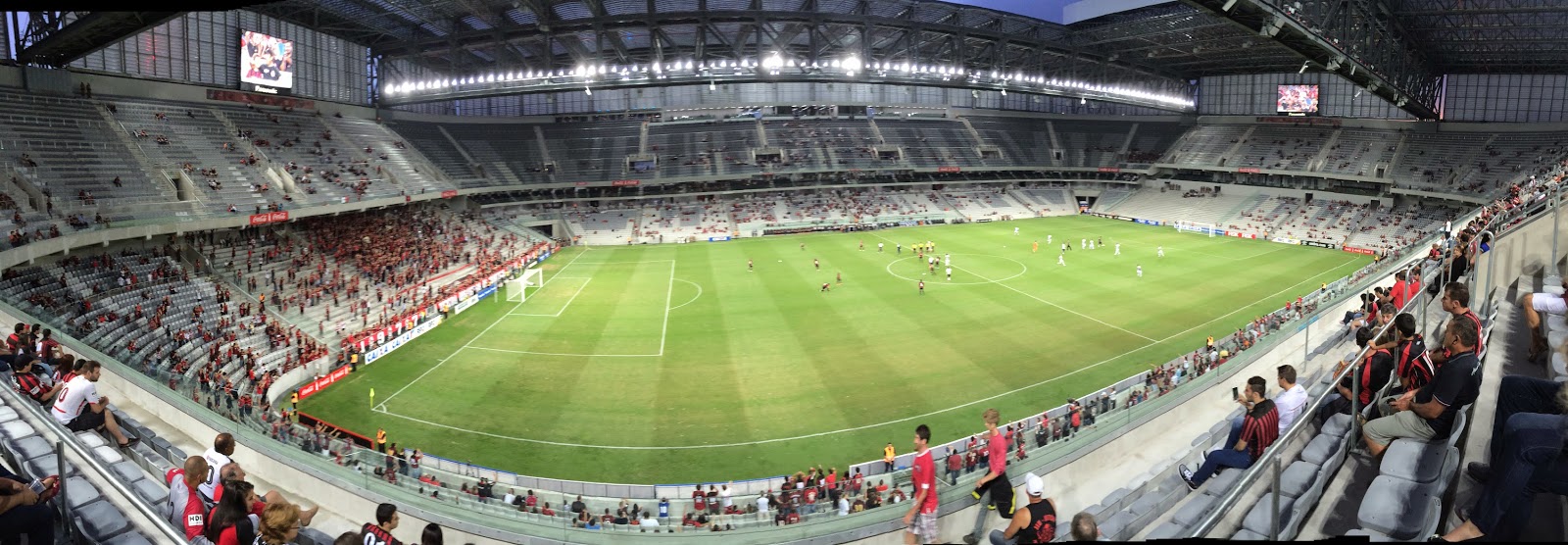
I’ve been following Atlético and watching them on tv for a few years now and I hoped the team would be in a better form than this for my first match at the Arena da Baixada.  Still, the opponents for the match were Maringá – a team from Séria D of the Campeonato Brasileiro and also skimming the relegation zone – hopefully Atlético would wake up and get a long awaited victory.  Fingers crossed…

We met some friends in a bar directly opposite the stadium.  The allegiances of the bar could never be called into doubt with Atlético’s signature black and red colours everywhere and memorabilia on the walls.  Fans drifted in and the bar gradually filled with a variety of team shirts from official replicas covering the last several years to classic team shirts to supporter’s t-shirts.  No two shirts were the same!  After a beer or few, we made our way to the stadium. 
Supporters in the bar before kick-off
We had a great view from our seats; high enough to see the whole pitch but low enough that we could see all the action.  It is customary to start Brazilian football matches with the national anthem, followed by the state anthem of Paraná.  I’m not sure which other states do that, but I don’t think I’ve seen the state anthem in Campeonato Paulista (São Paulo state) and Carioca (Rio de Janeiro state) matches.

After the anthems, it’s time for kick off and the bateria (the ever present drums) begin.  The bateria enhances the atmosphere of the game and gets everyone in the mood.  To my left, behind Atlético’s goal, the Fanáticos (the die-hard Atlético fans) were singing, jumping, and holding giant skulls.  The two main themes of the songs are how much they love Atlético and insulting their rivals, Coxa.  As the songs involve a certain amount of swearing, I won’t transcribe them here.
The Fanáticos - die-hard Atlético supporters
Atlético started the game strongly; pushing forward with plenty of shots.  They really looked like a winning team.  Before long, a penalty was converted to put them in the lead making a win seem all the more likely.  The fans went crazy!

The optimism was premature though, as numerous defending mistakes led to an equaliser for Maringá.  I’m sure their fans here happy although there were only between 10 and 20 of them, so the net result was stunned silence.  Around this point, Atlético seemed to fall apart, giving away possession and making school-boy mistakes.  The boo-ing of the crowd at the half-time whistle said it all.

Fanáticos with their backs turned
The second half continued in much the same fashion as the first ended.  Players were falling out of position leaving empty spaces for the Maringá players to move into.  Maringá made the most of these chances and it wasn’t long before they went 2-1 up against the home side.  The Fanáticos showed their disappointment by turning their backs (and the skulls) to the team while they continued to sing.  It didn’t take long before the singing focussed on how badly the team were playing and how angry the fans were: “s*** team” and “f*** off” to the team’s coach and president.  While the frustration that the fans felt is understandable, such chants took a clear toll on the morale of the players, making more and more silly mistakes.  The game was turning into a farce and several fans left early in disgust.

In the last 10-15 min, Atlético appeared to receive a second wind and took to the offensive once again, playing with skill and attacking Maringá’s goal, but it was too little, too late.  The damage had been done and they were unable to beat the keeper in what little time remained.

After the whistle, the stadium echoed to the sound of boo-ing and chants against the coach.  After such a bad run in games that should have been easy, it was clear that something had to change.  Indeed the day after the game, it was announced that the coach, Claudinei Oliveira, was leaving the club and a day after that, a new coach, Enderson Moreira, was announced.


It’s never fun to watch your team lose, especially in a game that they should easily win, but the atmosphere of the stadium along with the experience of watching a game with friends (who accused me of being Mick Jagger – dooming the game with my presence) made for an enjoyable experience.  I really hope the new coach can inspire them to improve and steer away from relegation to the second division of the Campeonato Paranaense, which would be the ultimate embarrassment.  And of course, in a couple of months, the Brasileirão begins – fingers crossed….
Inside the Arena da Baixada, Atlético Paranaense's home stadium

Friday, 15 August 2014

Brazilians and Football

Now that the excitement of the world cup is over, I'm going to write a bit about football (no, not soccer.)
For anyone who's been living in a cave for the past 60 or so years, Brazilians tend to really like (love? obsessed by?) football and are usually fairly good at it.  There has to be some talent to win the World Cup five times; more than any other country.  Of course not everyone likes football (I've met two, maybe three people that don't particularly like it) but there are enough fans to support a broad generalisation or two.

Now, if whilst in that cave you have been hiding under a big rock for the past couple of months, you might have missed the 2014 World Cup, which was hosted by Brazil for the second time.  I have already written about the mixed feelings I had to the World Cup and why my wife and I didn't go (http://maried-a-brazilian-support-group.blogspot.com/2014/05/why-were-not-going-to-world-cup.html) so I won't go into that here, but of course we got into the spirit and watched as many games as possible.  I'm going to just gloss over England's performance (AAAAAAAAARRRRRRRRRRRGGGGGGGGGGHHHHHHHHHHHH!) and move onto Brazil.  Some people picked out Argentina as favourites to win, some Spain, some Germany... I fancied Brazil's chances: a young team on home soil, fresh from a Confederations  Cup victory in 2013, it was theirs to lose.  And they managed that spectacularly.

I was in England for the semi-final against Germany, so I watched the game with beer in hand.  With no Neymar and no Tiago Silva, it was never going to be easy but it takes 11 men to form a team, surely these 11 could do it?  When the first goal went in, I thought "never mind, there's still time."  The second was a shock, but I've seen teams recover from worse.  Once the third went in, I had no idea what I was watching, they were disintegrating.  By five nil, the result was a foregone conclusion.

The media had a field day.  7-1 was everywhere - triumphant Germans, distraught Brazilians, tears streaming down their faces, the entire nation was devastated...

Or were they?

While everyone I spoke to was certainly disappointed (what football fan wouldn't be?) the truth is they had lost a match and exited from the World Cup - never mind, you can't win them all, better to lose to a good team.  Practically every Brit or American I've spoken to has asked how my wife felt about the result and my answer was always the same.  I show them this short video that was sent to me by three different Brazilians halfway through the second half...


No matter how you look at it, that is NOT uncontrollable grief!  That is seeing the funny side and having a laugh about it and that is what I love about Brazil and its people.  The next day, a friend re-tweeted a comment about predictions for the Netherlands vs Argentina match: "somehow, Germany wins!"

Old Brazilian gives his replica
World Cup to some German fans
Then in the final between Germany and Argentina; of course everyone was watching the match.  Were they supporting their South American hermanos of Argentina? Hoping for some revenge and the cup at least remaining in the continent?  Were they hell!  The semi-final was one game, but the footballing rivalry with Argentina runs deep!


So this may have been a post about football, but maybe it was a post about the spirit and sense of humour of the Brazilian people.

Tuesday, 6 May 2014

Why We're Not Going to the World Cup

If you like football, what could be better than a World Cup in Brazil?  Being there...

Go back a year or so and Sheila and I had a plan, we would go to Brazil for as much of the world cup as possible, enjoy the atmosphere and go to one Brazil match and one England match.  I'd been told about the atmosphere in Brazil during any world cup and with them hosting, we were sure the atmosphere would be electric.  We would watch the games with friends in bars, surrounded by people passionate about the beautiful game, share the celebrations and collectively commiserate the losses (well, I do support England...)  Neither of us had seen our national team playing live and this is something that should surely be put right.  The only doubt in my mind was whether or not England would qualify!  It was not unlikely that they would be left at home.


We visited Brazil in September 2012 for a week or so.  We were surprised to see that Guarulhos (São Paulo's main international airport) was chaotic as ever, this close to the World Cup.  We imagined thousands of football fans flooding into the country through here and Rio de Janeiro and wondered how they would cope.  Finding the hire care office was a challenge and that was being accompanied by a Brazilian; the staff in the immigration line seemed clueless; the signs in the airport were confusing at best.  How would they cope with masses of foreigners, many of whom would not speak a word of Portuguese?  Don't worry, we thought, with all the investment in infrastructure - every major stadium in the country was being renovated, surely they had budget for infrastructure? - it must improve.  By this point, Fantastico was running features on what must improve if Brazil is to play host to the World.

We drove from São Paulo to Curitiba, which was a hair raising experience.  The road is nicknamed Rodovia do morte - motorway of death - for good reason.  The tight turns in the mountains and some psychotic lorry drivers made it a real edge-of-the-seat experience.  Next I'll take the easy option and fly, as I'm sure most fans would do anyway. 

Arriving in Curitiba is always a relief.  This is a city that has been very well organised and has been recognised as one of the world's best examples of urban planning.  The bus network is well thought out with dedicated bus lanes, bendy buses and covered bus shelters (to keep out the constant threat of rain) and a fare collector so that boarding and disembarking is a quick and efficient affair.  If you prefer to drive, you face that same problems as any other city in the world.  It's not the easiest of places to find your way around if you are first time visitor (three letters for you: GPS) but it's no more difficult than any other city I've driven in.  Indeed, I have experienced a lot worse in London, Brussels, San Francisco.... But if you're only visiting for a short time, there is no need to hire a car, the bus network will more than suffice.
Arena da Baixada before it was torn down

As supporters of Atlético Paranaense, Sheila and I were happy that the Arena da Baixada had been chosen as one of the venues.  Dare we hope that England or Brazil would play there?  (Turns out, no.)  The Arena was a great example of a modern stadium; good access in and out of the ground, good seating and a great atmosphere.  All it was lacking was a stand along the South side of the pitch.  Aparently the owner of a school there was Coxa fan and blocked the building of another stand.  I heard this story, but have no idea whether it's true.  With the world cup coming, the club announced plans to upgrade the stadium: finally, they would have that fourth stand.

To our surprise, the renovations went beyond simply building a fourth stand.  Instead, the stadium that was built in 1999 was torn to the ground and rebuilt from the ground up.  I feel I must reiterate this point; the Arena da Baixada which was considered among Brazils most modern and best appointed stadia was torn down to be rebuilt from scratch.  To add insult to injury, the construction project was plagued by delays to the point that it found itself in the spotlight of the world-wide media as an example of how poorly the preparations for the World Cup were being managed.  For the people of Curitiba who are rightly proud of their city's reputation for efficiency, this was a huge embarrassment; there was even suggestions that the games to be held in Curitiba would be moved to another venue.  Thankfully, this appeared to spur on the works and not long ago, the stadium hosted a test friendly with invitations to all the workers that rebuilt the stadium

The Arena da Baixada is by no means the only stadium to suffer setbacks, the story of the crane collapse in São Paulo that resulted in the death of two workers was well reported around the world.  But this pails into significance against the corruption that has overshadowed the preparations.  The country promised massive improvements to infrastructure in order to cope with the influx of visitors.  There was talk of a new high speed train line between São Paulo and Rio de Janeiro, improvements to public transport, Curitiba would get an underground train network.  None of this has happened, the money seems to evaporate somehow...
Then we come to schools and hospitals.  Or maybe we don't...  Instead of private investment, many of the stadia were upgraded with public money.  When these projects inevitably went over-budget, with whispers about contracts being offered to friends and family or being delayed until the last minute so that the costs increase or maybe even due to money being pocketed (who does it hurt?  what's the harm?) then more money is taken away from schools, roads and hospitals.  After all, the last thing anyone wants is for the stadia to not be ready in time, embarrassing the government. 

Finally, in June 2013, the Brazilian people had enough.  In the midst of the Confederations cup, millions of people went onto the streets to protest against corruption and the high cost of hosting the World Cup.  The protests started in reaction to an increase in bus fares but soon grew to include corruption and police violence.  Social media allowed news to spread faster than traditional media (in fact Rede Globo, the Brazilian telecoms giant, appeared to ignore the protests on the first weekend) with people sharing photos and video of protests (see below) and police reactions under twitter hashtags such as #changebrazil (as well as #mudabrasil) and #semviolência (without violence.)  One such video that I cannot forget shows a gathering of protestors chanting ' sem violência' then being attacking by police with pepper spray, rubber bullets and truncheons. The protests spread to every major city in Brazil with many expats abroad demonstrating and forcing the issues into the global consciousness.


So, in light of all this, how can we go to the World Cup?  I have no doubt that the games will go ahead and they will be as exciting as always.  Indeed, we will be watching every England and Brazil match on TV, as well as many more. I don't want the World Cup to be a fiasco; part of me feels that the best thing is in fact to go, to feed the economy that should be paying for these projects.  But to go would be to justify the excessive expenses that Brazil cannot afford; to justify rebuilding entire stadia to satisfy FIFAs demands and to divert funds away from needy projects; to justify massive diversions while kids in the country's poorer regions go to schools that have broken chairs, no toilets and no electricity - watch video.

Brazil has the potential to be a great country, indeed many people have been raised from poverty into a growing middle class, but the speed of change is hampered but these levels of corruption.  By not going to the World Cup, we are not really protesting, but after our initial enthusiasm we no longer have an appetite for it.